

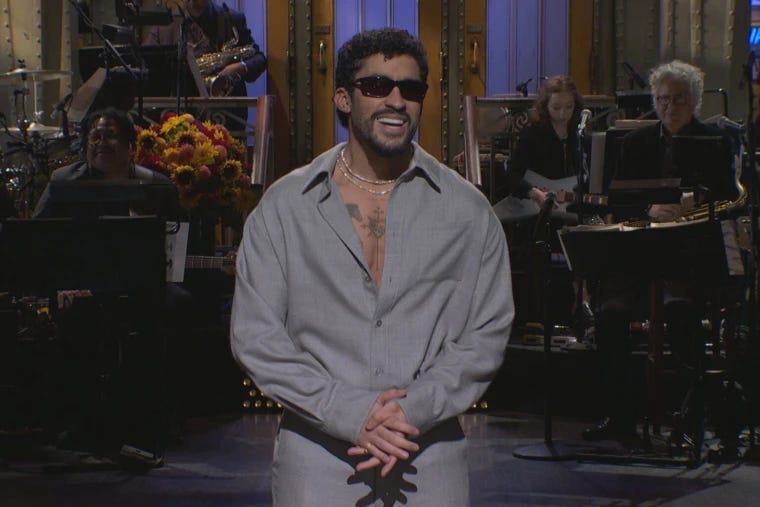
On September 28th, the National Football League announced that Puerto Rican superstar Bad Bunny would be performing at halftime of the upcoming Super Bowl. The backlash was instantaneous. Trump called it “absolutely ridiculous.” A petition to replace him with country singer George Strait received over 100,000 signatures. Prominent conservative commentator Matt Walsh called it “The most anti-American halftime show yet.”
Is this backlash justified?
Most estimates point to approximately 14% of the U.S. population speaking Spanish. That is significant, but of course, the overwhelming majority of NFL fans are English speakers. Meanwhile, exactly 0% of Bad Bunny’s songs are in English. Zero.
What more do you need to know? That alone makes this an extremely questionable choice, to put it lightly. Calling everyone who is upset about his upcoming performance a racist is not helpful. Surely there are some who have an anti-Latino sentiment, or are just mad that Bad Bunny is a leftist, but it’s reasonable to assume that most of them just want to understand the words in the music they are hearing. It’s straightforward.
Personally, I love many of Bad Bunny’s songs, but that’s mostly because I’ve become fluent in Spanish through studying it in college and putting in years of practice. While I can enjoy music in languages I don’t understand—many songs in French come to mind—I wouldn’t necessarily want to listen to an entire concert of French music during the intermission of a patriotic sporting event I love dearly. That would just be bizarre! I think many people feel this way.
Now, I can understand the accusations of many, like Matt Walsh, that this is a “political pick.” However—and I’m speculating here—I wouldn’t be surprised if people involved in the decision thought that it might be a good long-term financial pick for the league, as they continue to try to spread the game worldwide. It’s obvious the Spanish-speaking market is a key pillar of their globalization strategy. They’ve hosted games in Mexico City, and have their “Por La Cultura” initiative in which they celebrate Latino culture and players, among other efforts.
Considering how enormous Latin America is, it’s not hard to imagine why they would want to tap into these markets by putting the number one Latin star on stage during the biggest game. Whether this is a good idea is up for debate. By trying to bring in more fans from other countries, they are clearly angering much of their core base. It’s certainly a gamble of sorts, but not a totally crazy one.
Donald Trump may have “never heard of him,” but a lot of other people have, to say the least. Bad Bunny was the #1 most streamed artist on Spotify in 2025, with over 20 billion streams. He also achieved this feat in 2020, 2021, and 2022. In 2023 and 2024, the only person ahead of him was Taylor Swift.
This is Michael Jackson-level fame.
In any case, there is a deeper question beneath all of this, and it has less to do with Bad Bunny and more to do with the place of Spanish in the United States. The people who are bothered by the halftime show selection not because they don’t understand the language but because they don’t like Spanish being around in general, because they think it is wrong in the sense that it “shouldn’t be here,” sorely need a history lesson.
The reality is that the Spanish empire spread its language across North America for decades before the English ever arrived. To be super clear, this does not mean that the Biden administration’s recent handling of the southern border—which surely led to more Spanish speakers being here—was anything other than an absolute disaster. There is simply no world where it is good not to know who is coming into your country. What it does mean, however, is that historically, the Spanish language—Castellano, as the Spaniards call it—is as natural to the history of the Americas as the tradition of Thanksgiving. Whether people like it or not, that’s the truth. That’s how long it has been here. Los Angeles and San Diego and San Francisco are not called such for no reason.
The negative attitude some Americans take toward hearing other languages reminds me of the claim that America is a “Christian Nation.” Yes, the majority of people in the U.S. identify as Christian. But do proponents of this idea fail to read the literal first line in the First Amendment of the Constitution? Congress shall make no law respecting an establishment of religion. Does that sound like the opening declaration of a Christian theocracy? Quite the contrary. Similarly, the reality is that the U.S. has always had multiple languages in the mix alongside English; first and foremost among them being Spanish.
Should these Spanish speakers also know English? Yes, absolutely. Failing to do so is problematic in every area imaginable, including economic opportunities, community participation, and general safety. But to say they shouldn’t use Spanish—here in ‘Merica—is simply a reflection of sheer ignorance.
For example, take certain aspects of the history of Texas. In a Spanish class years ago, I recall learning about a famous saying among some Latinos in the region: No cruzamos la frontera, la frontera nos cruzó—we didn’t cross the border, the border crossed us.
After the U.S. won the war against Mexico, which ended in 1848, the Treaty of Guadalupe Hidalgo gave an incredible amount of land to the United States. The National Archives detail how “Mexico ceded 55 percent of its territory, including the present-day states California, Nevada, Utah, New Mexico, most of Arizona and Colorado, and parts of Oklahoma, Kansas, and Wyoming. Mexico also relinquished all claims to Texas, and recognized the Rio Grande as the southern boundary with the United States.” Surely many of the descendants of the ordinary people still live in these areas.
For many families in that region who speak Spanish, it is not that they crossed a border to come to an English-speaking land, it is that the government of their ancestors lost control of their homes in a war. This context—along with the legacy of the Spanish empire—is so important when we think about the prevalence of Spanish in the United States.
All that said, let me say once more that nowadays, the U.S. is still firmly, primarily a member of the Anglosphere. Yes, Spanish was here first, and will continue to be around, but the American state’s founding documents are in English, its most influential artistic achievements are in English, and most importantly, the majority of its population speaks English.
Therefore, much of this population quite reasonably wants their uniquely American event to be in their most common language. It’s unfortunate that none of this would be as much of an issue if Bad Bunny’s show had the ability to be more like Jennifer Lopez and Shakira’s halftime performance in the 2019 Super Bowl. Both with Latin backgrounds, they still have many of their biggest hits in English. For performing in this context, it would be ideal if Bad Bunny could follow their example. Alas, it won’t happen. Language barriers continue to be one of the most fundamental dividers of mankind.
WELL WRITTEN CARNAL..BUENAS SWERTE! JIMITO